

Top 25 Pull-Up Bar Exercises for Beginners (With Safe Progressions)
A pull-up bar is a simple piece of home fitness equipment that can support a wide range of strength exercises. But if you cannot do a single pull-up yet, you do not need to start with full pull-ups.
Instead, you can build your grip, upper-back, shoulder, arm, and core strength progressively. Bodyweight training can be effective without a traditional gym setup, and current American College of Sports Medicine guidance emphasizes consistency and progressive resistance training rather than complicated equipment or routines.
This guide covers 25 pull-up bar exercises, starting with beginner-friendly movements and progressing toward more demanding exercises.
Important: The exercises are not a mandatory progression for everyone. Your starting point should depend on your current strength, equipment, mobility, and comfort.
Why Pull-Up Bar Training Is Worth Trying
Pull-up bar exercises can train several major muscle groups, including the back, shoulders, arms, abdomen, and grip.
For general health, U.S. physical activity guidelines recommend that adults perform muscle-strengthening activities involving all major muscle groups on at least 2 days per week. Adults should also aim for at least 150 minutes of moderate-intensity aerobic activity each week, or an equivalent combination of moderate and vigorous activity.
You do not need to perform pull-ups every day to make progress. Consistency, appropriate difficulty, and gradual progression matter more than trying to do the hardest variation immediately. ACSM’s 2026 resistance-training guidance also emphasizes regular participation and individualized training.
Before You Start: Pull-Up Bar Safety
Before doing any hanging exercise, check your equipment carefully.
Check the Bar Installation
Follow the manufacturer’s installation instructions and weight limits. Make sure the bar is firmly secured before placing your full body weight on it.
If you use a doorway bar, check that it is properly positioned and stable before every workout.
Warm Up First
Spend a few minutes preparing your shoulders, elbows, wrists, and upper back.
You can use gentle arm circles, shoulder movements, and easy bodyweight exercises before hanging from the bar.
read also: How to Lose Weight Without Going to the Gym
Don’t Train Through Joint Pain
Normal muscular effort and fatigue are different from sharp, pinching, or unusual pain.
Stop the movement if you develop significant pain in your shoulder, elbow, wrist, or another joint.
Modify When Necessary
If you have a current injury, chronic health condition, or another concern that could affect exercise, speak with an appropriate healthcare professional about the type and amount of activity that is appropriate for you. CDC guidance specifically recommends individualized advice for people with chronic conditions or disabilities.
Top 25 Pull-Up Bar Exercises for Beginners- Beginner Pull-Up Bar Exercises: 1–8
These movements help you become comfortable with hanging and pulling before attempting more difficult variations.
1. Dead Hang

The dead hang is one of the simplest ways to start using a pull-up bar.
How to do it:
- Grip the bar with both hands.
- Let your arms extend naturally.
- Keep your body still.
- Maintain a comfortable grip.
- Hang only as long as you can control the position.
Beginner target: 10–20 seconds
Sets: 2–3
If your grip gives out quickly, that is okay. Start with a shorter hold and build gradually.
2. Active Hang

The active hang introduces more shoulder control than a relaxed dead hang.
How to do it:
- Grip the bar.
- Keep your elbows straight.
- Gently pull your shoulders away from your ears.
- Keep your torso controlled.
- Hold briefly before relaxing.
Think about creating space between your shoulders and ears rather than aggressively pulling your shoulder blades together.
Beginner target: 10–20 seconds
Sets: 2–3
3. Scapular Pull-Up

Scapular pull-ups teach you how to initiate a pulling movement with your shoulder blades.
How to do it:
- Start in a comfortable hang.
- Keep your elbows straight.
- Pull your shoulder blades down.
- Allow your body to rise slightly.
- Lower back to the starting position.
The movement should be small. Do not bend your elbows.
Reps: 6–10
Sets: 2–3
4. Hanging Knee Raise

Hanging knee raises add a core challenge while you are supported by the bar.
How to do it:
- Hang from the bar.
- Keep your torso controlled.
- Bend your knees.
- Slowly bring your knees toward your chest.
- Lower them without swinging.
Avoid using momentum to lift your legs.
Reps: 6–12
Sets: 2–3
5. Flexed-Arm Hang
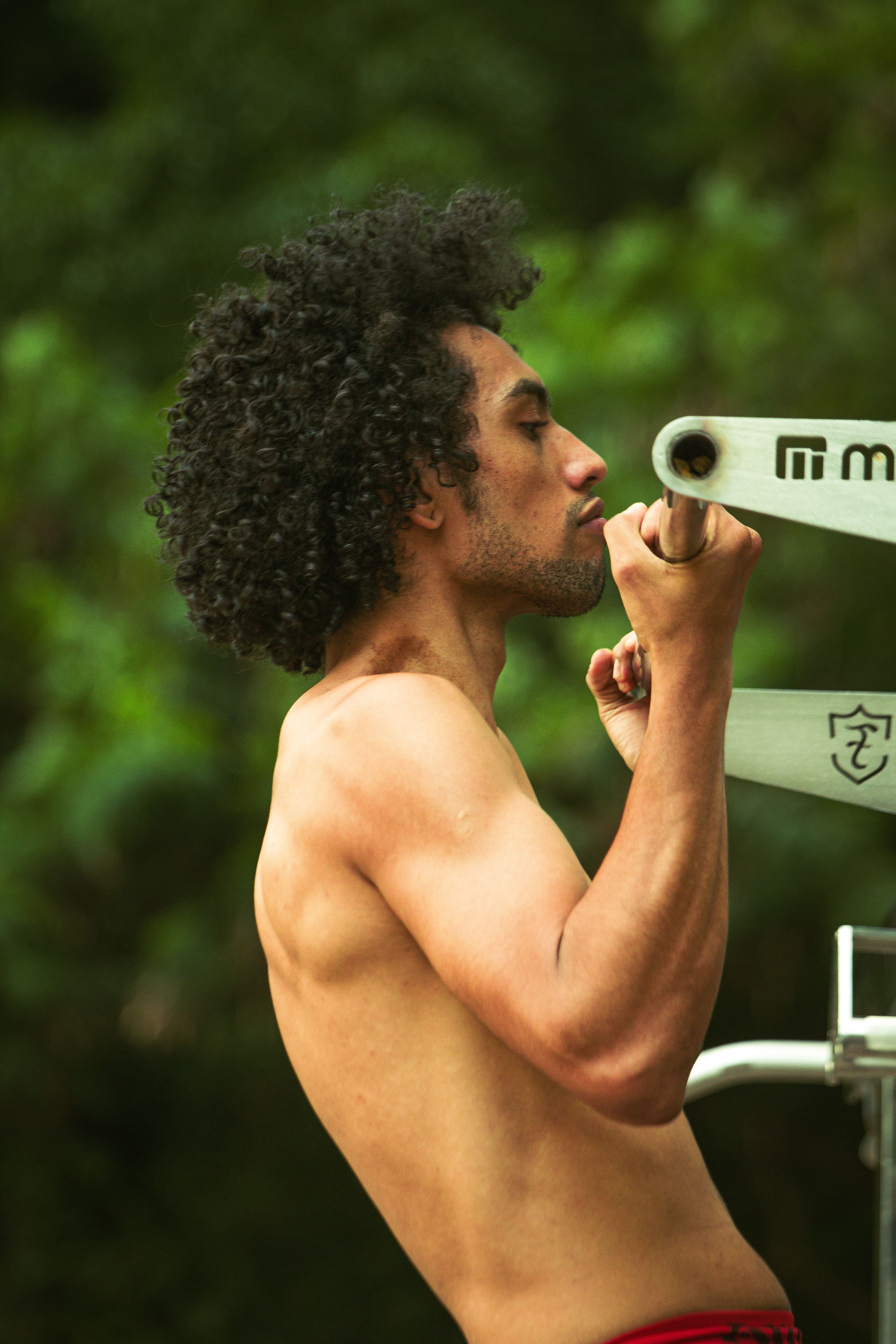
This exercise helps you practice the top portion of a pull-up.
Use a secure step or platform to reach the top position instead of jumping aggressively.
How to do it:
- Position your chin above the bar.
- Hold your body under control.
- Keep your shoulders active.
- Hold the position.
- Step down safely.
Hold: 5–15 seconds
Sets: 2–3
As you become stronger, gradually increase the hold time.
6. Negative Pull-Up

Negative pull-ups focus on the lowering portion of the movement.
How to do it:
- Use a secure step to reach the top position.
- Start with your chin above the bar.
- Remove your feet from the step.
- Lower yourself slowly.
- Finish with your arms extended in a controlled position.
Aim for a controlled descent rather than simply dropping.
Reps: 3–5
Sets: 2–3
7. Band-Assisted Pull-Up

A resistance band can reduce the amount of body weight you need to pull.
How to do it:
- Secure a suitable resistance band around the bar.
- Place your foot or knee into the band according to the band’s design.
- Grip the bar.
- Pull upward while maintaining control.
- Lower yourself slowly.
Use a band that provides enough assistance to let you maintain good technique.
Reps: 5–10
Sets: 2–3
As you become stronger, you can gradually use less assistance.
8. Australian Pull-Up

An Australian pull-up, also called an inverted row, changes the pulling angle and can be easier than a full pull-up.
Only perform it if your bar can be securely positioned at an appropriate height.
How to do it:
- Position yourself underneath the bar.
- Hold the bar with both hands.
- Keep your body relatively straight.
- Pull your chest toward the bar.
- Lower yourself slowly.
Reps: 8–12
Sets: 2–3
Pull-Up Progression Exercises: 9–16
Once you have developed basic hanging and pulling control, you can experiment with more challenging variations.
read also: Pelvic Floor Exercises for Women Benefits You Should Know
9. Chair-Assisted Pull-Up

A stable step or chair can reduce the amount of work required from your upper body.
How to do it:
- Place a stable support underneath the bar.
- Grip the bar.
- Keep one or both feet lightly supported.
- Pull your chest upward.
- Use your legs only as much as necessary.
- Lower under control.
Reps: 5–8
Sets: 2–3
Do not use an unstable chair.
10. Partner-Assisted Pull-Up

A training partner can provide controlled assistance during the movement.
How to do it:
- Grip the bar.
- Begin the pull-up.
- Have your partner provide light assistance at your legs or hips.
- Pull yourself upward.
- Lower slowly.
Your partner should assist only as much as needed.
Reps: 5–8
Sets: 2–3
11. Jackknife Pull-Up

This variation uses a supported lower-body position to reduce the amount of resistance.
How to do it:
- Position your feet on a secure elevated surface.
- Grip the bar.
- Keep your feet supported.
- Pull your body upward.
- Use your legs to provide controlled assistance.
Reps: 5–8
Sets: 2–3
Make sure the support is stable before starting.
12. Wide-Grip Pull-Up

A wide-grip pull-up places your hands farther apart than a standard shoulder-width grip.
If full repetitions are too difficult, use the movement as an assisted pull-up or negative.
How to do it:
- Grip the bar wider than shoulder width.
- Keep your body controlled.
- Pull your chest upward.
- Avoid excessive swinging.
- Lower slowly.
Reps: 3–8
Sets: 2–3
A wider grip is not automatically better. Use a hand position that feels comfortable for your shoulders.
13. Close-Grip Pull-Up

A close grip brings your hands closer together and can change how the pulling movement feels.
How to do it:
- Grip the bar with your hands relatively close.
- Keep your shoulders controlled.
- Pull upward.
- Keep your body steady.
- Lower under control.
Reps: 3–8
Sets: 2–3
14. Chin-Up

The chin-up uses an underhand grip, with your palms facing toward you.
How to do it:
- Grip the bar with your palms facing you.
- Start from a controlled hanging position.
- Pull your body upward.
- Bring your chin over the bar.
- Lower slowly.
Reps: 3–8
Sets: 2–3
Some beginners find chin-ups more manageable than overhand pull-ups, but individual experience varies.
15. Commando Pull-Up

The commando pull-up uses a narrow grip with your hands close together on the bar.
How to do it:
- Position your hands close together.
- Face along the length of the bar.
- Pull your head toward one side of the bar.
- Lower yourself.
- Repeat toward the opposite side.
Reps: 3–6
Sets: 2–3
Use a comfortable range of motion and avoid forcing your shoulders into an awkward position.
16. Towel Grip Hang

A towel can make gripping the bar more challenging.
How to do it:
- Place a strong towel securely over the bar.
- Grip both sides of the towel.
- Lift your feet from the floor.
- Maintain a controlled hang.
- Step down safely.
Hold: 10–20 seconds
Sets: 2–3
Use a strong towel and check that it does not slip before committing your full body weight.
Full Pull-Up Movements: 17–20
These variations require more pulling strength and control.
17. Strict Pull-Up

The strict pull-up is the traditional overhand pull-up.
How to do it:
- Grip the bar with your palms facing away.
- Start from a controlled hanging position.
- Keep your body stable.
- Pull your elbows toward your sides.
- Continue until your chin clears the bar.
- Lower yourself under control.
Avoid kicking, swinging, or using excessive momentum.
Reps: 1–8
Sets: 2–4
18. Strict Chin-Up

The strict chin-up uses an underhand grip.
How to do it:
- Grip the bar with palms facing you.
- Begin from a controlled hang.
- Pull your body upward.
- Bring your chin over the bar.
- Lower slowly.
Reps: 1–8
Sets: 2–4
19. Neutral-Grip Pull-Up

A neutral-grip pull-up uses handles that allow your palms to face each other.
Not every pull-up bar has this option.
How to do it:
- Grip the neutral handles.
- Start with your arms extended.
- Keep your torso controlled.
- Pull upward.
- Lower slowly.
Reps: 3–8
Sets: 2–3
20. Slow-Tempo Pull-Up

The slow-tempo pull-up emphasizes control instead of speed.
How to do it:
- Start from a controlled hang.
- Pull upward smoothly.
- Pause briefly near the top.
- Lower yourself slowly.
- Avoid swinging throughout the movement.
Reps: 2–5
Sets: 2–3
If you cannot perform a full slow pull-up yet, practice slow negatives instead.
read also: 25 Best Simple Exercises to Reduce Belly Fat for Female at Home
Core and Advanced Pull-Up Bar Exercises: 21–25
These exercises require greater grip, shoulder, and core control.
21. Hanging Knee Raise

Although already useful for beginners, hanging knee raises can become progressively harder.
How to do it:
- Hang from the bar.
- Keep your torso stable.
- Bend your knees.
- Bring your knees toward your chest.
- Lower slowly.
Reps: 8–15
Sets: 2–3
Avoid swinging your body to create momentum.
22. Hanging Leg Raise

The hanging leg raise increases the lever length compared with a knee raise.
How to do it:
- Hang from the bar.
- Keep your legs extended.
- Brace your core.
- Raise your legs with control.
- Lower them slowly.
Reps: 5–10
Sets: 2–3
If straight-leg raises are too difficult, return to knee raises.
23. Windshield Wipers

Windshield wipers are an advanced hanging core exercise.
How to do it:
- Hang securely from the bar.
- Raise your legs.
- Keep them controlled.
- Move your legs gradually toward one side.
- Return through the center.
- Move toward the opposite side.
Reps: 3–6 per side
Sets: 2–3
Do not attempt this movement until you can comfortably control hanging leg raises.
24. L-Sit Hang

The L-sit hang combines grip strength with significant core and hip-flexor demand.
How to do it:
- Grip the bar.
- Lift your feet from the floor.
- Raise both legs in front of you.
- Aim for approximately a 90-degree hip position.
- Hold without swinging.
Hold: 5–15 seconds
Sets: 2–3
If keeping your legs straight is too difficult, slightly bend your knees.
25. Skin the Cat

Skin the cat is an advanced movement that combines hanging strength and shoulder mobility.
It is considerably more demanding than the beginner exercises in this list.
How to do it:
- Start from a secure hanging position.
- Raise your legs toward the bar.
- Carefully rotate your body through the shoulders.
- Move only through a comfortable range.
- Reverse the movement under control.
Reps: 2–5
Sets: 1–2
Do not force the range of motion. If you have limited shoulder mobility or a shoulder injury, get individualized professional guidance before attempting this movement.
How to Build Your Pull-Up Training
You don’t need all 25 exercises in one workout.
A simpler approach is to choose 4–6 exercises that match your current level.
Beginner
- Dead hang — 2 × 10–20 seconds
- Active hang — 2 × 10–20 seconds
- Scapular pull-up — 2 × 6–10
- Negative pull-up — 2 × 3–5
- Australian pull-up — 2 × 8–12
Intermediate
- Scapular pull-up — 2–3 × 8
- Band-assisted pull-up — 3 × 5–8
- Chin-up — 3 × 3–6
- Negative pull-up — 2 × 3–5
- Hanging knee raise — 2–3 × 8–12
More Advanced
- Strict pull-up — 3 × 3–8
- Chin-up — 3 × 3–8
- Slow-tempo pull-up — 2 × 2–5
- Hanging leg raise — 2–3 × 5–10
- L-sit hang — 2 × 5–15 seconds
The CDC notes that 8–12 repetitions can be used as one set of a muscle-strengthening activity, with one or more sets depending on the individual. However, pull-ups and advanced variations may naturally require fewer repetitions.
How Often Should You Train With a Pull-Up Bar?
For general strength training, adults should perform muscle-strengthening activities on at least 2 days per week and work all major muscle groups.
You do not need to train the same pulling muscles at maximum effort every day.
A simple schedule could be:
Monday: Pull-up training
Tuesday: Walking or other activity
Wednesday: Rest or lower-body training
Thursday: Pull-up training
Friday: Rest
Saturday: Optional light practice
Sunday: Rest
Your schedule can be adjusted based on your training experience and recovery.
How to Progress Toward Your First Pull-Up
If you currently cannot do a pull-up, don’t measure progress only by whether your chin reaches the bar.
Look for smaller improvements.
You might progress from:
10-second dead hang → 20-second dead hang → active hang → scapular pulls → controlled negatives → assisted pull-ups → first strict pull-up.
You can also make progress by doing more repetitions, holding positions longer, or gradually reducing assistance.
ACSM’s 2026 guidance emphasizes choosing an approach that fits your goals and progressing gradually rather than relying on complicated training methods.
Frequently Asked Questions
How long does it take to do your first pull-up?
There is no reliable universal timeline.
Your starting strength, training consistency, body size, technique, and previous exercise experience can all affect your progression.
Some people progress relatively quickly, while others need considerably longer.
Instead of setting a fixed deadline, track measurable improvements such as hang time, negative-control time, or assisted-pull-up repetitions.
Can beginners do pull-up bar exercises?
Yes. Beginners can start with easier movements such as dead hangs, active hangs, scapular pull-ups, assisted pull-ups, and inverted rows.
Choose a variation that allows you to maintain control.
Can I train pull-ups every day?
You can practice low-intensity movements more frequently, but repeatedly training difficult pulling movements to fatigue may not be necessary.
If your muscles are still significantly fatigued or sore, allow more recovery before another hard session.
Can pull-up exercises improve posture?
Strengthening the upper back and shoulder muscles can contribute to overall muscular function, but posture depends on multiple factors.
Pull-up training should not be presented as a guaranteed solution for posture problems.
Are doorway pull-up bars safe?
They can be used safely when they are compatible with the doorway, correctly installed, and used within the manufacturer’s specifications.
Always inspect the bar before using it and follow the manufacturer’s instructions.
Do I need to stretch before pull-ups?
You do not necessarily need a long stretching session.
A short warm-up that prepares your shoulders, elbows, wrists, and upper back can be a practical way to prepare for hanging and pulling.
Final Thoughts
You don’t have to be able to do a pull-up before you start pull-up training.
Dead hangs, active hangs, scapular pulls, assisted pull-ups, negatives, and inverted rows give you several ways to build toward the movement.
Start with a variation you can perform with control. Then gradually increase the challenge as your strength improves.
Most importantly, don’t compare your first week with someone else’s fifth year of training.
For overall health, combine strength training with regular aerobic activity. Current U.S. guidelines recommend at least 150 minutes of moderate aerobic activity per week plus muscle-strengthening activity on at least 2 days per week for adults.
If you have an injury, chronic condition, or persistent joint symptoms, get individualized advice from an appropriate healthcare professional before starting challenging hanging exercises.