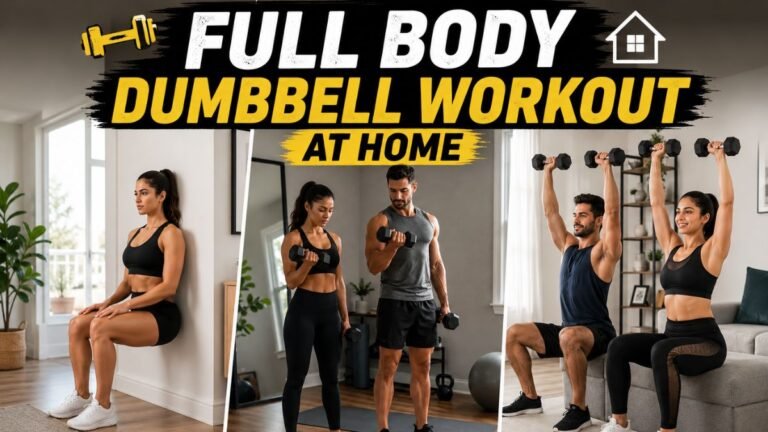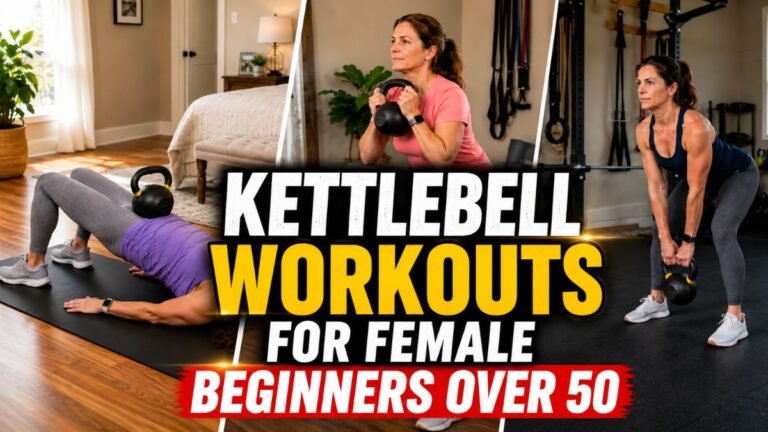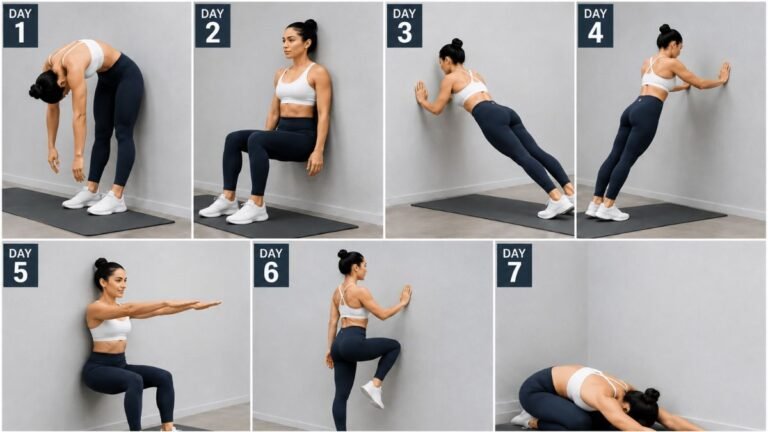
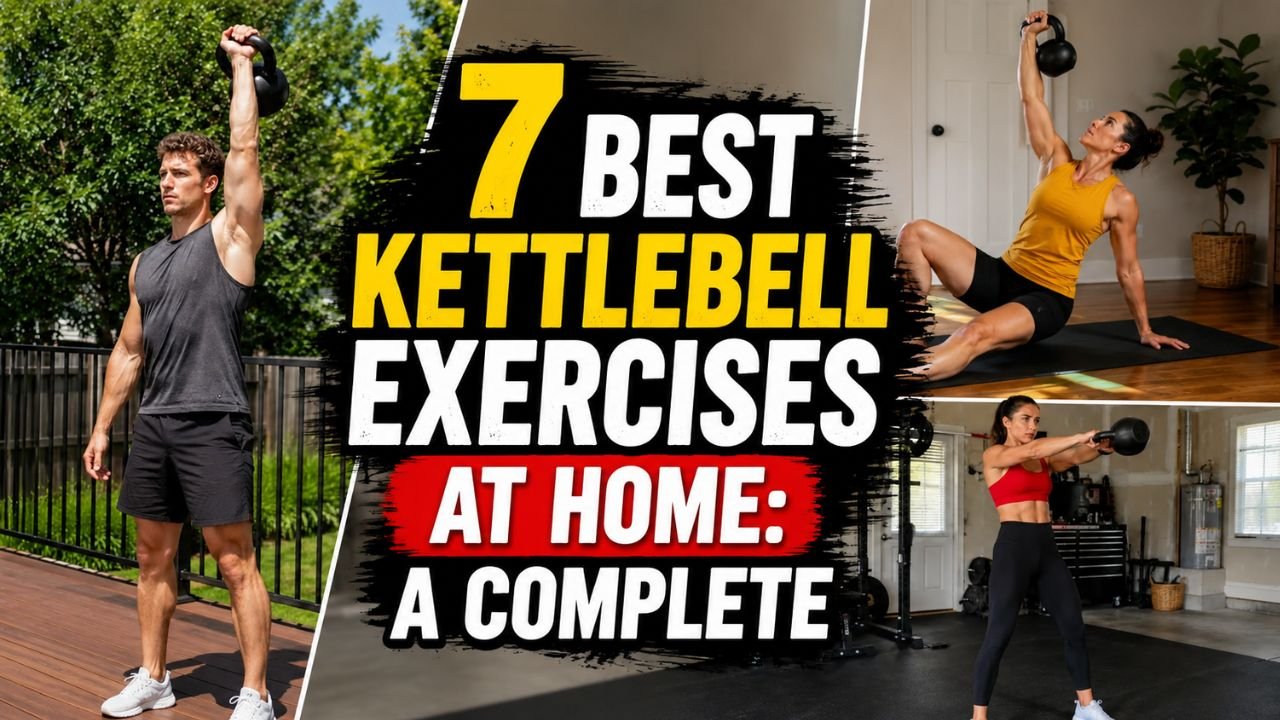
7 Best Kettlebell Exercises at Home: A Complete, Research-Backed Guide
You don’t need a room full of machines to get strong. One kettlebell, a small patch of floor, and 20 minutes a few times a week is enough to train your entire body legs, back, shoulders, arms, and core all at once. That’s the real appeal of kettlebell training: it replaces an entire gym’s worth of equipment with a single tool.
This guide breaks down the 7 best kettlebell exercises you can do at home, why they work, and how to do them safely, based on how trainers and strength coaches actually program kettlebell workouts for real people.
The Right Angle for This Topic
The most genuine angle for a “kettlebell exercises at home” article isn’t “advanced athletic training” — it’s “minimal equipment, maximum function.” People searching this topic usually have one kettlebell, limited space, and want to know:
- Which exercises actually work multiple muscles at once?
- What’s safe to do without a trainer watching form?
- How much space and equipment do I really need?
- How do I progress without getting hurt?
So the article is built around simplicity, safety, and efficiency — a handful of exercises that cover the whole body, rather than an overwhelming list of 20+ moves nobody will remember.
Why Kettlebells Work So Well for Home Training
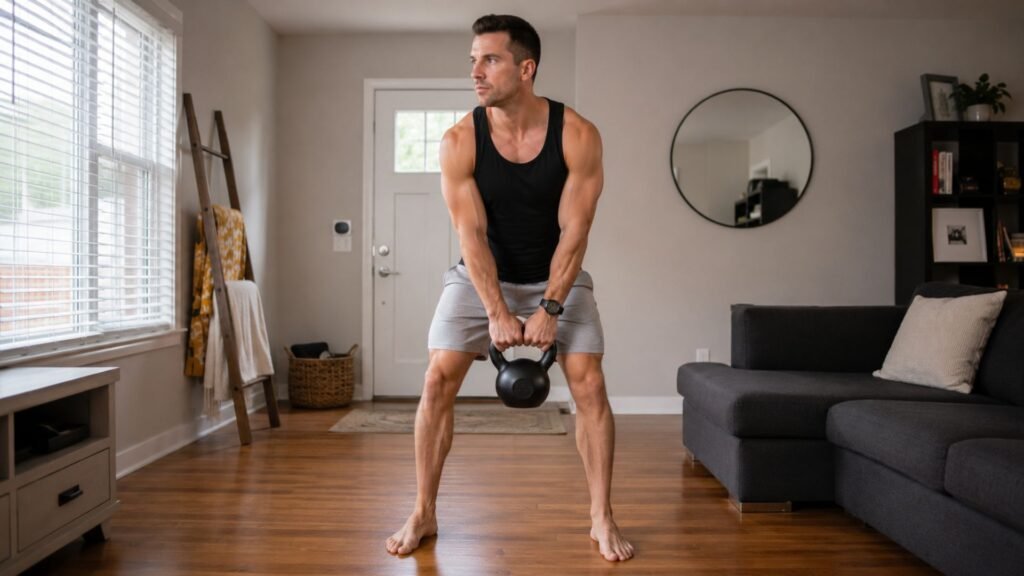
A kettlebell’s weight hangs below the handle instead of being centered like a dumbbell. That off-center load forces your core, grip, and stabilizing muscles to work on almost every exercise — which is why a single kettlebell can train your whole body more efficiently than many other tools.
| Benefit | Why It Matters for Home Training |
|---|---|
| Full-body engagement | The off-center load activates the core on nearly every movement |
| Space-efficient | One kettlebell and a small area is all you need |
| Builds strength and cardio together | Ballistic moves like swings raise heart rate while building power |
| Improves coordination and balance | Uneven weight distribution trains stabilizer muscles |
| Affordable | A single kettlebell is a one-time cost compared to a full equipment set |
| Scalable | Works for beginners with a light bell and advances easily as strength grows |
Safety Tips Before You Start
- Choose the right weight. Most beginners do well starting around 8–12 kg (18–26 lb) for women and 12–16 kg (26–35 lb) for men, adjusting based on comfort.
- Warm up for 5–10 minutes with light cardio and hip/shoulder mobility drills before lifting.
- Master the hip hinge first — most kettlebell injuries come from squatting a swing instead of hinging at the hips.
- Keep your back flat, not rounded, during hinges, swings, and deadlifts.
- Start light and prioritize form over reps or weight — kettlebells punish poor technique quickly.
- Give yourself space — at least a few feet in every direction, especially for swings.
- Stop if you feel sharp pain, especially in the lower back, shoulders, or wrists.
The 7 Best Kettlebell Exercises for Home Workouts
1. Kettlebell Swing
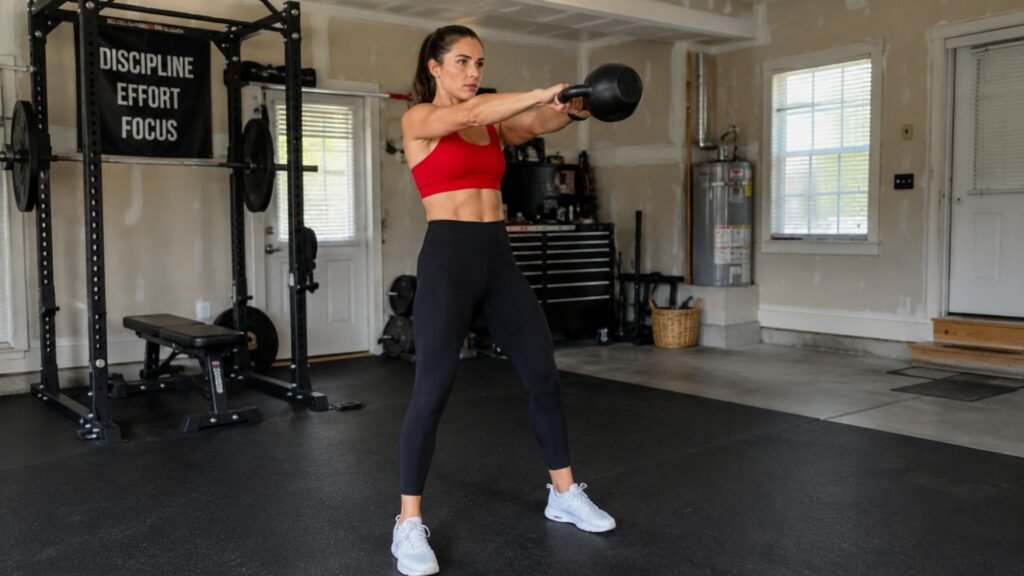
Stand with feet shoulder-width apart, kettlebell on the floor in front of you. Hinge at your hips (not your knees) to grip the handle. Hike the bell back between your legs, then drive your hips forward explosively to swing it up to chest height, arms staying relaxed and straight. Works: glutes, hamstrings, lower back, core, shoulders. Why it’s essential: It’s the foundation of kettlebell training — builds explosive hip power and doubles as a cardio move. Sets/reps: 3 sets of 10–15 reps.
2. Goblet Squat
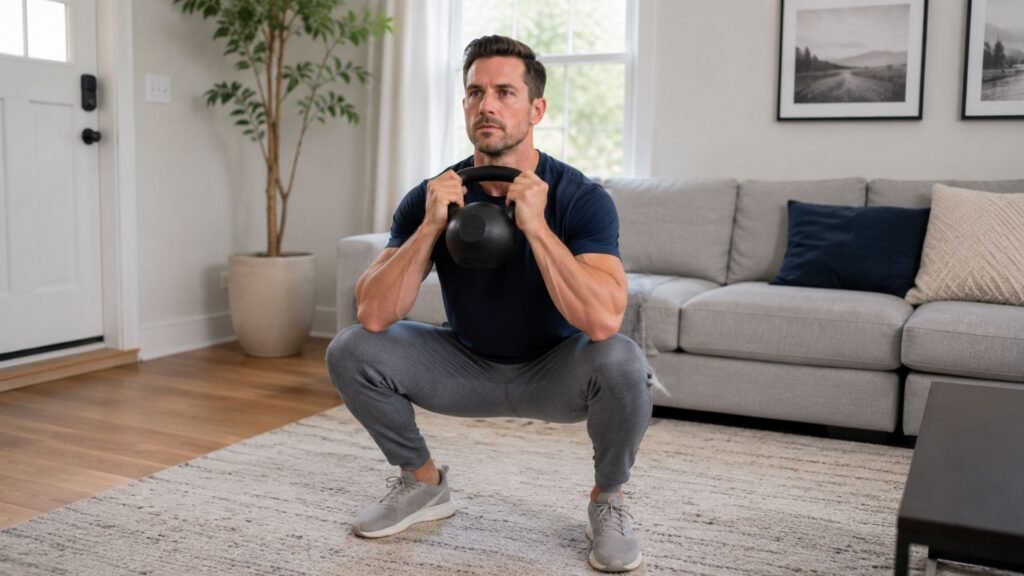
Hold the kettlebell close to your chest by the horns (sides of the handle), elbows tucked in. Squat down by pushing your hips back and bending your knees, keeping your chest lifted, then drive through your heels to stand. Works: quads, glutes, core. Why it’s essential: Holding the weight at chest height naturally improves squat depth and posture compared to a bodyweight squat. Sets/reps: 3 sets of 10–12 reps.
3. Turkish Get-Up
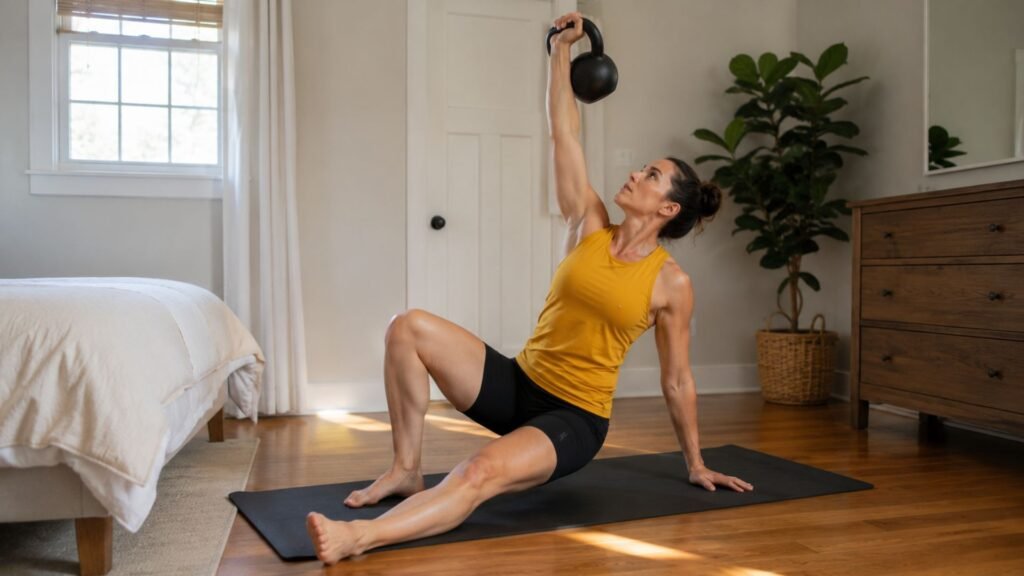
Lie on your back holding the kettlebell above one shoulder, arm locked straight. Using your opposite arm and leg for support, work your way up through your elbow, hand, and a half-kneeling position until you’re standing — then reverse the movement back down with control. Works: shoulders, core, hips, full-body stability. Why it’s essential: Considered one of the most complete strength and stability exercises in kettlebell training; it teaches control through nearly every joint in the body. Sets/reps: 3–5 slow, controlled reps per side (start without weight if you’re new to the movement).
4. Single-Arm Row
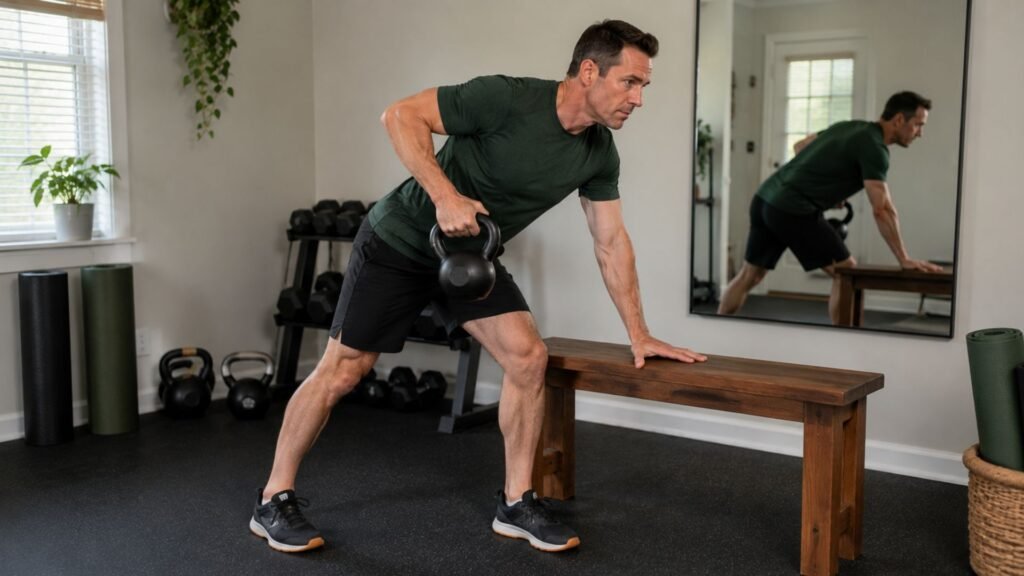
Hinge forward with one hand on a chair or bench for support, torso close to parallel with the floor. Hold the kettlebell in the opposite hand and pull it up toward your ribs, squeezing your shoulder blade, then lower with control. Works: upper back, lats, biceps, core. Why it’s essential: Balances out all the pushing and hinging movements by strengthening the back and improving posture. Sets/reps: 3 sets of 8–12 reps per side.
5. Suitcase Carry
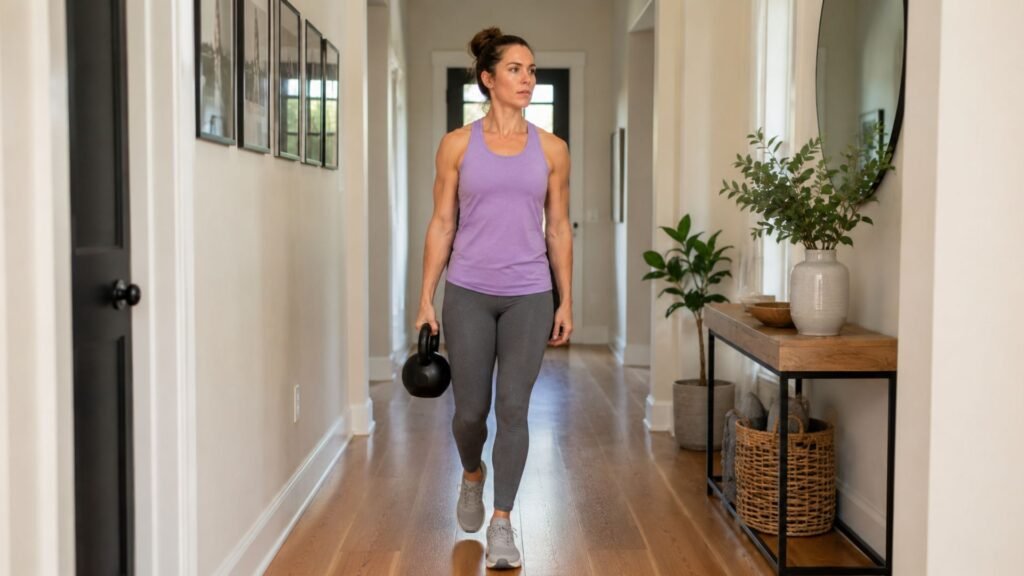
Hold a kettlebell in one hand at your side, standing tall like you’re carrying a suitcase. Walk forward for a set distance or time, keeping your torso upright and resisting the urge to lean to one side. Works: core (obliques), grip, shoulders, legs. Why it’s essential: Trains anti-rotation core strength and grip endurance — both directly useful for carrying real-life loads like grocery bags. Sets/reps: 3 sets of 20–30 seconds per side.
6. Overhead Press
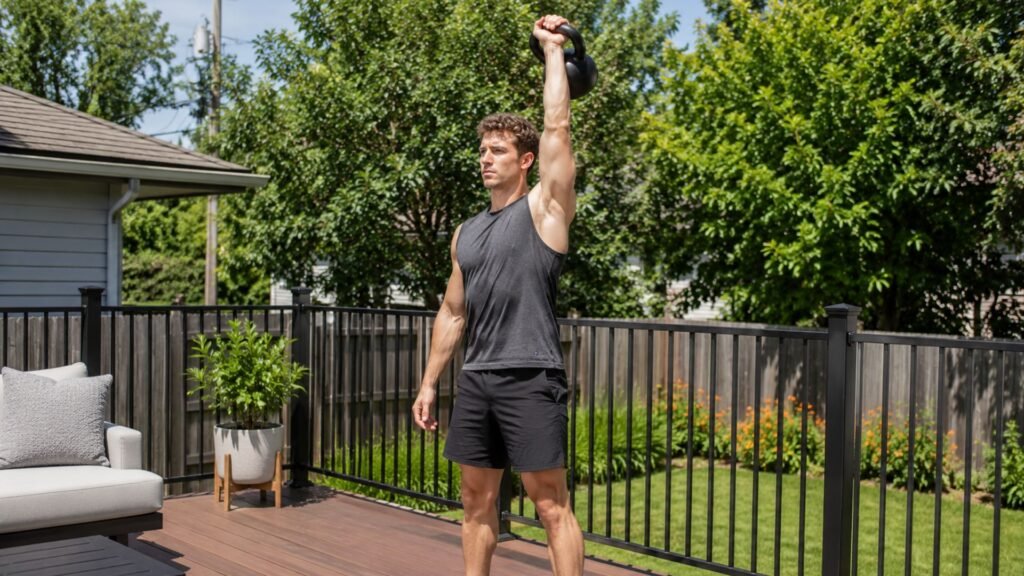
Stand with feet hip-width apart, holding the kettlebell at shoulder height in one hand, elbow tucked. Press it straight overhead until your arm is fully extended, then lower back to shoulder height with control. Works: shoulders, triceps, upper back, core. Why it’s essential: Builds pressing strength and shoulder stability, useful for any overhead reaching or lifting task. Sets/reps: 3 sets of 8–10 reps per side.
7. Russian Twist
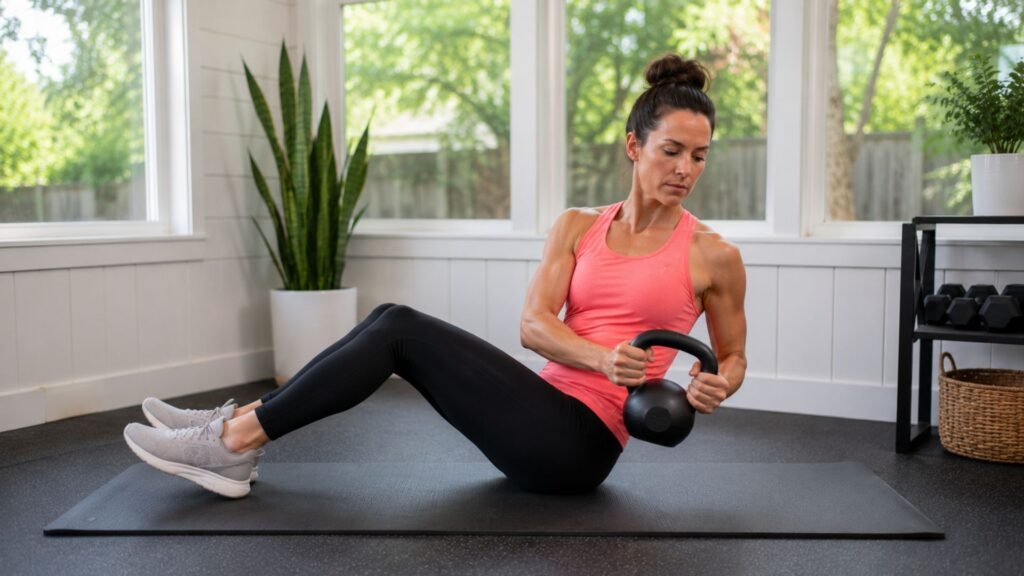
Sit on the floor with knees bent, leaning back slightly to engage your core, feet either lightly touching the floor or lifted for more challenge. Hold the kettlebell with both hands and rotate your torso to tap the bell down on each side. Works: obliques, deep core, rotational stability. Why it’s essential: Strengthens the rotational core muscles used in almost every real-world twisting movement, from swinging a bag to turning in a car seat. Sets/reps: 3 sets of 10–15 reps per side.
Sample At-Home Kettlebell Routine
| Day | Focus | Exercises |
|---|---|---|
| Day 1 | Power + Legs | Kettlebell Swing, Goblet Squat, Suitcase Carry |
| Day 2 | Rest or light mobility | — |
| Day 3 | Upper Body + Core | Single-Arm Row, Overhead Press, Russian Twist |
| Day 4 | Rest | — |
| Day 5 | Full Body | Turkish Get-Up, Kettlebell Swing, Goblet Squat |
Rest 30–60 seconds between sets when starting out, and increase intensity gradually as your form and confidence improve.
Frequently Asked Questions
How heavy a kettlebell should I buy for home use? Most beginners do well with a single kettlebell in the 8–16 kg range, choosing a weight that allows 10–12 clean reps of a goblet squat without breaking form.
Can one kettlebell really replace a full gym setup? For general strength, mobility, and conditioning goals, yes — a single kettlebell combined with the seven exercises above covers pushing, pulling, hinging, squatting, carrying, and rotating, which are the core movement patterns most workouts are built around.
How often should I train with kettlebells? Three non-consecutive days a week is a solid starting point, allowing muscles to recover between sessions.
Is the kettlebell swing bad for the lower back? Not when done correctly. Most back strain comes from squatting the swing instead of hinging at the hips — focus on pushing your hips back, not bending your knees deeply.
Final Thoughts
Kettlebell training earns its reputation because it’s efficient — one tool, a handful of movements, and a workout that trains almost every muscle group at once. These 7 exercises cover every major movement pattern (push, pull, hinge, squat, carry, rotate, and full-body integration), which means you don’t need a complicated program to get real results at home. Start light, focus on form, and build up consistently.
disclaimer: This article is for general informational purposes and is not a substitute for professional coaching or medical advice. If you have any existing injuries or health conditions, consult a doctor or qualified trainer before starting a new exercise program.