free 28 day wall pilates challenge pdf
Sculpt your core. Improve your posture. Build a daily habit using nothing but a wall, a mat, and 15–30 minutes a day.
NO EQUIPMENT • NO GYM • ALL LEVELS • 4-WEEK PLAN INSIDE
A complete daily workout guide, printable tracker, and expert tips to help you finish what you start.
For informational purposes only. Consult a doctor before beginning any new exercise program.
Welcome to Your Challenge
Wall Pilates has become one of the most popular at-home fitness trends of the last two years and for good reason. It takes the core-strengthening, posture-improving principles of traditional Pilates and adapts them using a simple bare wall for support, resistance, and feedback. There is no reformer machine to buy, no studio membership to pay for, and no complicated choreography to memorise.
The wall does three jobs at once. It acts as a stable prop that makes balance-challenging moves safer for beginners and older adults. It creates light resistance that intensifies bodyweight exercises like bridges and squats. And it gives you constant tactile feedback on your alignment, helping you keep good form even without a mirror or instructor in the room.
This guide lays out a complete, progressive 28-day plan — four weeks, seven days each, with built-in rest days — so you always know exactly what to do and when. Whether your goal is a stronger core, better posture, more flexibility, or simply the satisfaction of finishing a challenge you started, this plan is designed to meet you where you are and build from there.
“You don’t need a studio to transform how you move — you just need a wall and 15 minutes.”
What Makes Wall Pilates Different
- Low impact on joints — the wall offers stability that makes movements gentler, which is ideal for injury prevention or recovery.
- Better alignment — the wall acts as a tactile guide, so your body learns correct positioning even without a trainer watching.
- Built-in resistance — pressing into the wall adds muscle tension to moves like bridges and squats without needing extra weights.
- Accessible anywhere — all you need is roughly six feet of clear wall space and a mat; no equipment purchases required.

Benefits You Can Expect
- A visibly stronger, more defined core and improved abdominal control.
- Better posture and spinal alignment from daily practice against the wall.
- Increased flexibility, especially through the hips, hamstrings and shoulders by week three.
- Improved balance, coordination and body awareness.
- A calmer mind — many participants report reduced stress and better sleep from the mindful breathing built into each session.
- The confidence of finishing a structured 4-week commitment, which often carries into other healthy habits.
A note on expectations: Pilates burns fewer calories than high-intensity cardio, but research on regular Pilates practice links consistent sessions with meaningful improvements in body composition, strength, balance and mood over time — particularly when paired with balanced nutrition. Most people notice reduced bloating and improved posture within the first one to two weeks, with strength and flexibility gains building through week three and four.
How the Challenge Works
This is a simple, no-excuses format: one focused workout a day, six days a week, for four weeks, with a lighter recovery day built into each week. Each day targets a specific area — glutes, core, upper body, full body, or balance — so that by the end of the month you’ve trained every major muscle group multiple times.
Before You Start
- Clear a 6 ft × 6 ft wall space, free of frames, switches, or furniture.
- Grab a mat, towel, or soft rug for floor-based moves.
- Wear comfortable clothing that allows a full range of motion.
- Take a Day 1 photo and, if you like, basic measurements (waist, hips) to track change over time.
- Set a realistic time of day you can commit to for the next 28 days — consistency matters far more than intensity.
The Ground Rules
- Form over speed. Every exercise should feel controlled from start to finish.
- Modify, don’t skip. If a move is too hard, reduce range of motion or reps rather than skipping the day entirely.
- Rest days count. Days 7, 14, 21 and 28 are lighter recovery days — your body improves during rest, not just during effort.
- Progress isn’t always visible immediately. Trust the plan; most noticeable change builds from week 3 onward.
- Repeat if you love it. Many people restart the challenge at a higher intensity or move on to full-length Pilates sessions once the 28 days are complete.
Your Complete 28-Day Plan
Below is your full day-by-day roadmap. Each week has a specific theme and builds in intensity, so the moves that feel challenging in week one will feel more manageable by week three — right as new, harder variations are introduced.
Week 1 — Foundation & Alignment
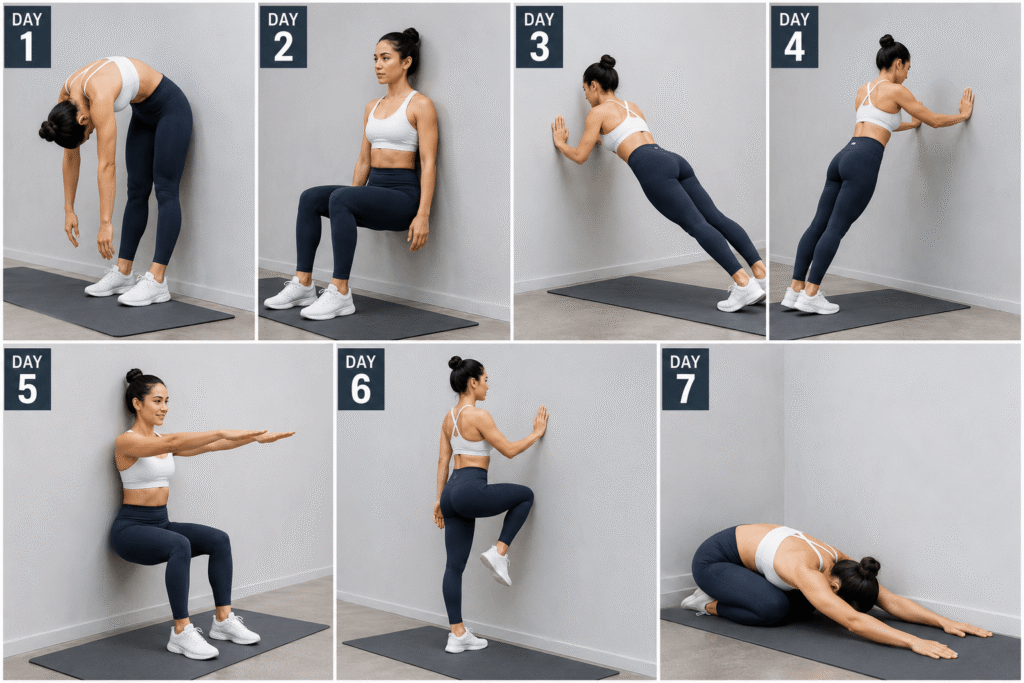
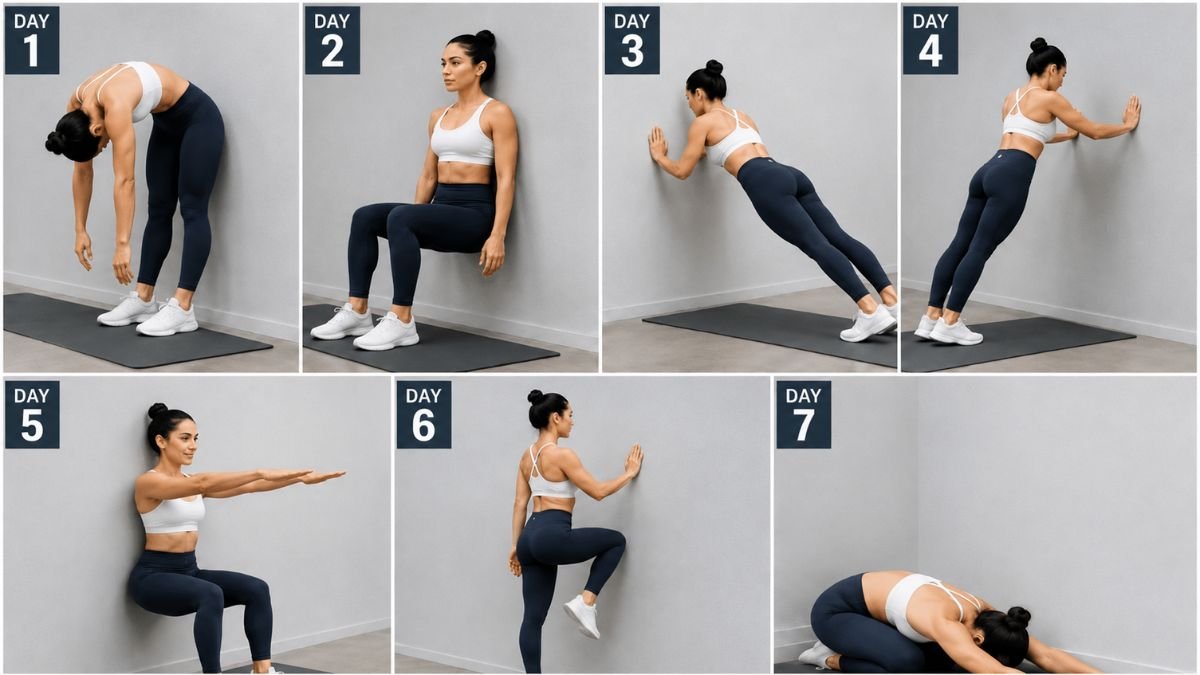
Focus on learning the wall as your guide. Move slowly, breathe, and prioritise clean form over speed or reps.
| Day | Focus | Duration | Key Moves |
|---|---|---|---|
| 1 | Posture & Core Activation | 15 min | Wall roll-down, wall sit, dead bug |
| 2 | Lower Body Foundations | 15 min | Wall squat hold, glute bridge (feet on wall), calf raise |
| 3 | Core & Breathing | 15 min | Wall plank, pelvic curl, bird-dog |
| 4 | Upper Body & Posture | 15 min | Wall push-up, wall angel, shoulder blade squeeze |
| 5 | Full-Body Flow | 20 min | Wall squat + reach, standing leg lift, side plank (modified) |
| 6 | Balance & Stability | 15 min | Single-leg wall reach, wall-assisted tree pose, ankle circles |
| 7 | Rest & Recovery | 10 min | Wall child’s pose, chest opener stretch, deep breathing |
Week 2 — Building Strength
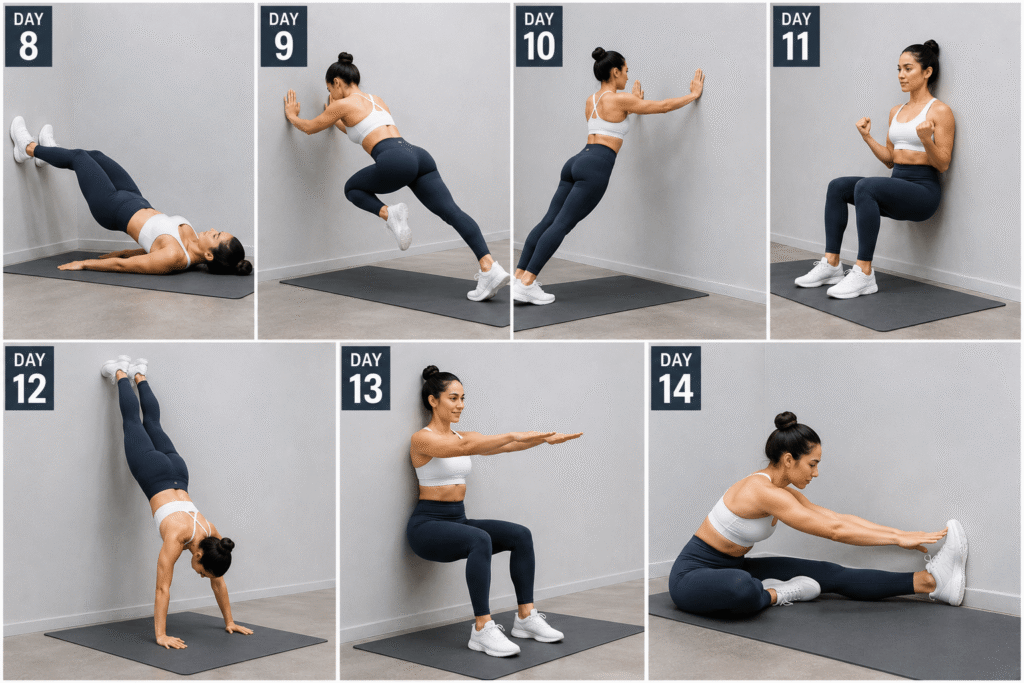
Hold positions a little longer and add small pulses. Your core should feel more engaged than week 1.
| Day | Focus | Duration | Key Moves |
|---|---|---|---|
| 8 | Glutes & Hamstrings | 20 min | Elevated glute bridge, wall clam shell, hamstring wall stretch |
| 9 | Core Sculpt | 20 min | Wall plank with knee tap, reverse crunch, standing oblique twist |
| 10 | Upper Body Tone | 20 min | Incline wall push-up, wall tricep dip, arm circles against wall |
| 11 | Full-Body Burn | 20 min | Wall sit + bicep pulse, curtsy lunge (hand on wall), plank hold |
| 12 | Balance & Core | 20 min | Wall handstand prep (feet up), standing knee-to-chest, plank shoulder taps |
| 13 | Lower Body Sculpt | 20 min | Wall squat pulses, side leg raise, wall-supported lunge |
| 14 | Rest & Recovery | 10 min | Wall hamstring stretch, spinal twist, box breathing |
Week 3 — Intensity & Control
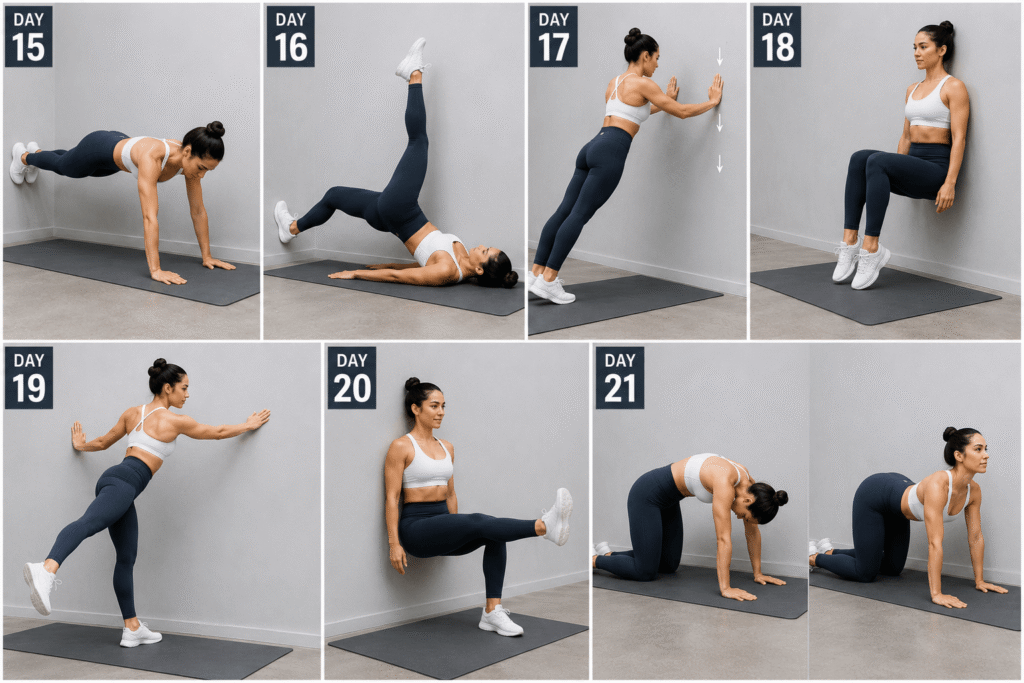
Slow the tempo down further to increase time-under-tension. Add optional resistance band if available.
| Day | Focus | Duration | Key Moves |
|---|---|---|---|
| 15 | Core Power | 25 min | Wall plank walk-out, hollow hold (feet on wall), bicycle crunch |
| 16 | Glute Focus | 25 min | Single-leg glute bridge, wall donkey kick, fire hydrant |
| 17 | Upper Body Endurance | 25 min | Wall push-up ladder, tricep kickback, shoulder press against wall |
| 18 | Full-Body Flow | 25 min | Wall squat to calf raise, plank jack (modified), standing crunch |
| 19 | Balance & Agility | 25 min | Single-leg wall reach with twist, wall-assisted warrior III, heel-to-toe walk |
| 20 | Total-Body Sculpt | 25 min | Wall sit with leg extension, side plank dips, superman hold |
| 21 | Rest & Recovery | 10 min | Wall cat-cow, figure-4 stretch, guided breathing |
Week 4 — Peak Challenge
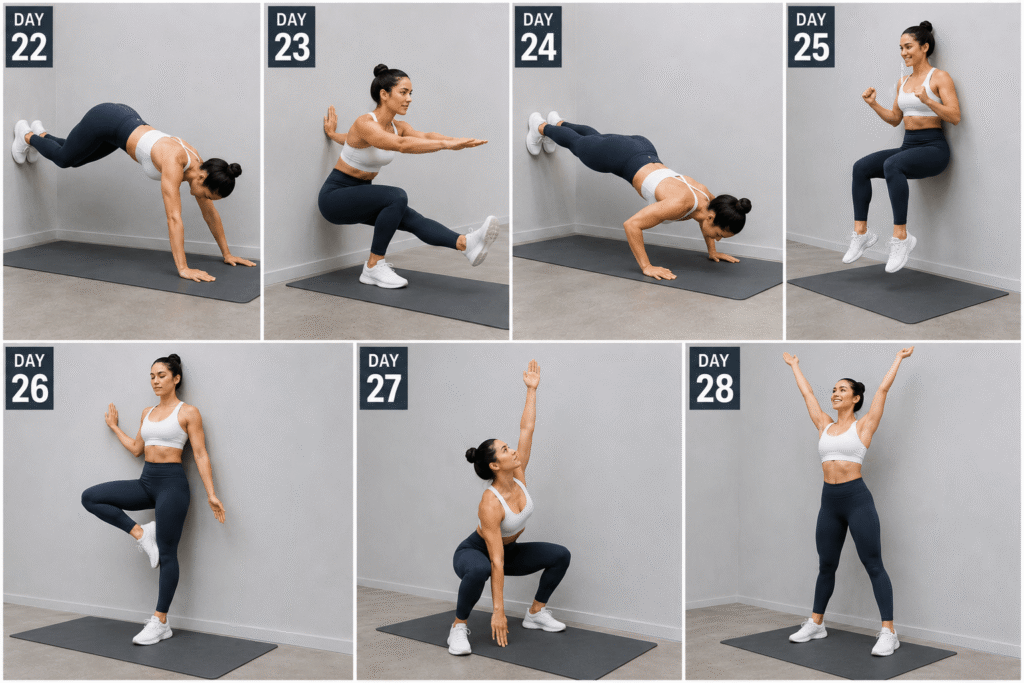
This is your strongest week. Combine everything you’ve learned; slow, controlled, full range of motion.
| Day | Focus | Duration | Key Moves |
|---|---|---|---|
| 22 | Core Finisher | 25-30 min | Wall plank to pike, weighted reverse crunch feel, side plank rotation |
| 23 | Lower Body Peak | 25-30 min | Pistol squat prep (wall-assisted), pulse lunges, wall sit hold 60s |
| 24 | Upper Body Peak | 25-30 min | Decline wall push-up, tricep press combo, wall angel with pulse |
| 25 | Full-Body Challenge | 25-30 min | Wall squat jump (low impact), plank to bridge, standing oblique crunch |
| 26 | Balance Mastery | 25-30 min | Single-leg wall series, eyes-closed balance hold, warrior III flow |
| 27 | Total-Body Finale | 25-30 min | Full circuit — repeat favourite moves from weeks 1-3 at your hardest level |
| 28 | Celebration & Reflection | 15 min | Full-body stretch flow, gratitude breathing, take your Day 28 photos |
Key Exercise Library
New to some of the terms in your daily plan? Here are step-by-step cues for eight of the foundational moves you’ll come back to again and again throughout the 28 days. Aim for 2-3 sets of 8-12 reps (or a 20-40 second hold for static positions), increasing hold time or reps as the weeks progress.
Wall Roll-Down Stand with your back against the wall, feet a few inches away. Slowly round your spine forward, one vertebra at a time, reaching toward your toes, then roll back up to standing. Builds spinal mobility and core awareness.
Wall Sit Slide down the wall until your knees form a 90-degree angle, thighs parallel to the floor. Hold, keeping your back flat against the wall. Strengthens quads, glutes and core endurance.
Glute Bridge (feet on wall) Lie on your back with your feet pressed flat against the wall, knees bent. Lift your hips toward the ceiling, squeezing your glutes at the top, then lower with control. Targets glutes and hamstrings.
Wall Plank Place your forearms or hands against the wall at chest height and walk your feet back until your body forms a straight diagonal line. Hold, keeping your core tight. A joint-friendly way to build plank strength.
Wall Push-Up Stand facing the wall, hands shoulder-width apart at chest height. Bend your elbows to bring your chest toward the wall, then push back. Builds chest, shoulder and arm strength with less load than a floor push-up.
Wall Angel Stand with your back flat against the wall, arms bent in a goalpost position touching the wall. Slowly slide your arms up and down like making a snow angel, keeping contact with the wall. Improves posture and shoulder mobility.
Single-Leg Wall Reach Stand a small step from the wall, lift one knee, and use light fingertip contact on the wall for balance as you hinge forward on the standing leg. Builds balance, ankle stability and hamstring strength.
Wall-Assisted Warrior III Facing away from the wall, hinge forward at the hips, extending one leg back until it lightly touches the wall for support, arms reaching forward. Develops balance, core control and posterior-chain strength.
Tips for Success
- Warm up for 2-3 minutes with light marching or arm circles before each session.
- Keep your lower back gently pressed toward the wall or floor during core work to protect your spine.
- Breathe out on the effort (the lift, the push, the squeeze) and in as you release.
- Quality over quantity: a slow, controlled rep is worth more than a fast, sloppy one.
- Take a progress photo and simple measurements on Day 1, Day 14 and Day 28 to track visible change.
- Stay hydrated and aim for a protein-containing snack within an hour of finishing a session.
- Listen to your body — mild muscle fatigue is normal, sharp or joint pain is a signal to stop and modify.
Simple Fuel & Recovery Guidelines
You don’t need a strict diet to benefit from this challenge, but a few basics support better results: eat a source of protein with most meals to support muscle recovery, stay consistently hydrated throughout the day, and avoid drastically cutting calories — your body needs steady energy to complete each session well. A small snack such as fruit and yoghurt 30-60 minutes before your workout can help performance, especially on higher-intensity days in weeks three and four.
Weekly Check-In Tracker
Use this simple tracker to note how each week felt — energy, soreness, and mood — to see your own progress in black and white.
| Week | Days Completed | Energy (1-5) | Notes |
|---|---|---|---|
| Week 1 | ___ / 7 | ___ | |
| Week 2 | ___ / 7 | ___ | |
| Week 3 | ___ / 7 | ___ | |
| Week 4 | ___ / 7 | ___ |
Frequently Asked Questions
Do I need any equipment? No. All you need is a clear stretch of wall roughly six feet wide and a mat for comfort on the floor. A resistance band or light dumbbells are optional add-ons for later weeks if you want extra intensity.
How much time does each day take? Most days take 15 to 30 minutes, with the time gradually increasing as the weeks progress and rest days built in on days 7, 14, 21 and 28.
Will this help me lose weight? Wall Pilates is primarily a strength, posture and mobility practice. Combined with a balanced diet and consistent activity, many participants notice improved muscle tone, posture and reduced bloating, but individual results vary.
Is it suitable for beginners or older adults? Yes. The wall provides support and feedback that makes movements safer and more accessible than free-standing Pilates, which is part of why the format works well for beginners, seniors and anyone easing back into exercise.
What if a move feels too hard or too easy? Modify freely. Reduce range of motion or reps if something feels too intense, or add a light band, extra pulses, or a longer hold if it feels too easy. Progress at your own pace — consistency matters more than perfection.
Can I repeat the challenge? Absolutely. Many people repeat the 28 days at a higher intensity, move on to traditional Pilates or strength training, or simply keep doing 2-3 wall Pilates sessions a week for maintenance.
You’re Ready to Begin
The 28-Day Wall Pilates Challenge works because it removes every common excuse — no equipment, no gym, no complicated routine, and never more than 30 minutes a day. Find your wall, roll out your mat, and start with Day 1. By Day 28, you won’t just have a stronger core and better posture — you’ll have proven to yourself that you can commit to something and see it through.
Day 1 starts today. Find your wall.
Disclaimer: This guide is intended for general informational and educational purposes only and does not constitute medical or professional fitness advice. Always consult a qualified healthcare provider before beginning any new exercise program, especially if you are pregnant, recovering from injury, or have an existing medical condition. Modify or stop any exercise that causes pain.